

Key Takeaways
- FlexMoney is a loan marketplace, not a direct lender. It connects your request with participating lenders that make their own lending decisions.
- One online request can reach lenders in the network, but submitting your information does not guarantee an offer or approval.
- Your information may be shared with lenders and third-party partners, so reviewing the site’s privacy disclosures is an important step.
- If a lender makes an offer, review the APR, repayment terms, fees, and total cost before accepting.
- You can research lender licensing, consumer reviews, and complaint records before deciding whether to borrow.
You’re considering an online loan, but before entering your income, banking details, and other personal information, you want to know exactly who you’re dealing with. Is FlexMoney the company lending you money? Who receives your information? And what happens after you submit a request?
Those are reasonable questions, especially when you’re comparing online loans and trying to understand which companies are involved.
FlexMoney connects borrowers with participating lenders rather than issuing loans itself. That distinction matters because the company handling your initial request isn’t necessarily the company that will review your credit, provide an offer, or collect your payments.
Here’s how the process works, what you should know about the lender network, and how to check the details before appling for an online lending solution.
What Is FlexMoney, and Is It a Direct Lender?
FlexMoney USA, operated through flexmoney.com, is an online lending connection platform. It’s also described as a loan marketplace, meaning it helps connect people looking for loans with lenders that may be able to review their requests.
FlexMoney doesn’t issue loans or make credit decisions. Its role is to collect the information you submit and forward it to participating lenders and partners.
A direct lender operates differently. It evaluates your application, decides whether to approve it, provides the funds, and manages repayment according to your agreement.
That means there are two companies you may need to understand when using a loan marketplace:
- FlexMoney: The platform where you submit your initial loan request.
- The participating lender: The financial company that evaluates your information, determines eligibility, and provides the loan if you accept its offer.
If you receive an offer, the lender’s identity should be clear in the documentation. That’s the company whose terms, licensing, and customer service arrangements you should review before signing.
This distinction also explains why FlexMoney reviews and reviews of individual lenders may describe different experiences.
How Does the FlexMoney Lender Network Work?
You don’t have to approach every lender separately to find out whether one might consider your request. A loan marketplace gives you a starting point through one online form.
Here’s what happens when you submit your information.
Step 1: Complete the Online Loan Request
The process begins with an online form asking for information lenders use to evaluate borrowing requests.
Depending on the form and your circumstances, this may include your contact information, address, employment or income details, requested loan amount, and banking information.
FlexMoney describes its initial request process as taking approximately five minutes, although completion time can vary.
Before submitting, review the information you’re providing and the disclosures explaining how it may be used. Submitting a request isn’t the same as accepting a loan.
Step 2: Your Request Is Sent to Participating Lenders
Once submitted, your information may be forwarded to lenders and third-party partners in the network.
Not every lender operates in every state, and loan availability depends on where you live. FlexMoney’s guide to online loan options by state explains how location can affect the options available.
The important point is that one request doesn’t mean every lender in the network will review your information or make an offer.
The network creates an opportunity for lender consideration, not a guarantee of approval or multiple offers.
Step 3: Lenders Review Your Financial Information
Each participating lender applies its own eligibility and underwriting criteria.
A lender may review your income, credit history, existing debt, and ability to manage the proposed payments. One common measure is your debt-to-income ratio, which compares your monthly debt obligations with your income.
Lenders may also request a credit report from Experian, Equifax, or TransUnion, or use an alternative consumer reporting provider.
Credit-check procedures can differ between lenders. Before continuing with an offer, check whether the lender may perform a hard inquiry and how that could affect your credit.
A lower credit score doesn’t necessarily prevent a lender from considering your request, but each lender decides whether you qualify.
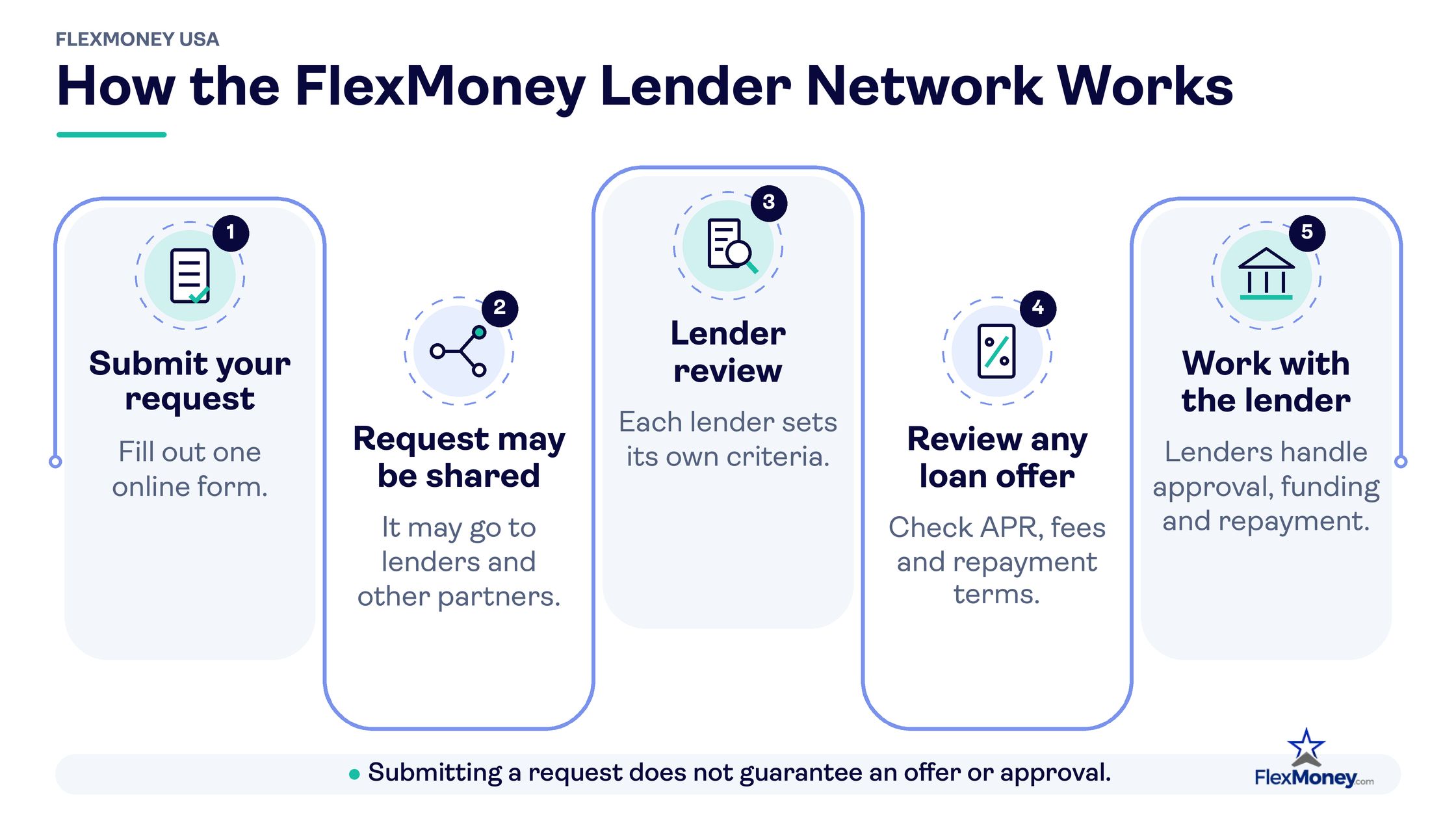
Step 4: Review Any Available Loan Offer
If a lender is interested in your request, you may be presented with loan terms to review.
An offer should identify the lender and explain the amount, annual percentage rate (APR), repayment schedule, fees, and other important conditions.
You may also need to complete additional verification or provide supporting information before the lender makes a final decision.
An offer isn’t an obligation to borrow. You can review the details and decide whether the loan fits your circumstances.
Step 5: The Lender Handles Approval, Funding, and Repayment
If you proceed, the lender is responsible for its final approval process and the loan agreement.
After approval and completion of the required steps, the lender arranges funding. Some participating lenders may provide funds as soon as the next business day, but actual timing depends on the lender, verification requirements, and your financial institution.
Once the loan is active, your repayment obligations are governed by the agreement with that lender.
If you have questions about a payment, payoff amount, or account balance, start with the lender identified in your loan documents.
Who Sees Your Personal Information?
One of the biggest differences between applying through a loan marketplace and approaching a single lender is how your information may be shared.
FlexMoney’s published disclosure explains that information submitted through its website may be forwarded to lenders and third-party partners. Participating lenders may also obtain consumer reports when evaluating creditworthiness.
That means the company receiving your initial request may not be the only organization processing your information.
The Consumer Financial Protection Bureau’s Circular 2024-01 discusses how digital intermediaries can influence which financial providers consumers are shown. It is useful context when evaluating how online comparison and matching services operate.
Before sharing sensitive information, review the marketplace’s privacy policy and consent language. Pay particular attention to:
- Information sharing: Which lenders, service providers, or marketing partners may receive your details?
- Communication consent: Could submitting the form lead to emails, phone calls, or text messages?
- Privacy choices: What options are available for limiting certain uses or sharing of your information?
These details matter because consenting to have your information considered by lenders may also involve other permissions described in the site’s disclosures.
FlexMoney vs. Applying Directly to an Online Lender
Is it better to use a loan marketplace or go straight to a lender?
Neither approach is automatically the right choice. It depends on how you prefer to research your options and whether you already have a particular lender in mind.
| What to compare | FlexMoney loan marketplace | Applying to one direct lender |
| Where you start | One online request | The lender’s application process |
| Who reviews your information | Participating lenders or partners that receive your request | The lender you contact |
| Who makes the credit decision | The participating lender | The direct lender |
| Number of potential lenders | More than one may consider your request, but offers aren’t guaranteed | One lender per application |
| Who provides the funds | The lender whose offer you accept | The lender identified in your agreement |
| Who handles repayment | The lender identified in your agreement | The lender identified in your agreement |
| What to verify | Marketplace disclosures and the lender’s terms | The lender’s disclosures and terms |
A marketplace may be useful when you’re exploring which lenders might consider your request. Going directly to a lender may be more straightforward when you’ve already researched that company and its loan products.
In either case, the final decision should come down to the lender, the terms offered, and whether the repayment obligation fits your budget.
How Can You Check Whether FlexMoney and Its Lenders Are Legitimate?
When researching a financial website, it’s worth checking more than its homepage or customer testimonials.
The same basic checks apply to loan marketplaces and direct lenders. They help you understand who’s involved, what borrowing could cost, and whether there are warning signs.
| What to check | Why it matters | What to look for |
| Who actually lends the money | The marketplace and lender may be different companies | FlexMoney states that it isn’t a lender or credit decision-maker |
| Published loan terms | You need enough information to evaluate potential costs | APR disclosures, repayment examples, fees, and lender-specific terms |
| Upfront payment requests | Advance-fee loan scams can target people seeking credit | The FTC explains why legitimate lenders don’t ask you to pay before you get a loan |
| Lender licensing | Lending requirements vary by state | Check the named lender through your state regulator or NMLS Consumer Access where applicable |
| Complaint history | Complaints may reveal issues worth investigating | Search the CFPB Consumer Complaint Database for relevant companies |
These checks are particularly useful when a marketplace introduces you to a lender you haven’t heard of before.
For example, if you receive an offer from a participating lender, search the lender’s legal business name rather than relying only on the marketplace’s brand name.
Keep in mind that a complaint database is not a verified list of wrongdoing. Complaints reflect consumer reports, and the presence or absence of complaints doesn’t independently establish whether a company is trustworthy.
What Should You Check Before Accepting a Loan Offer?
Finding a lender willing to consider your request is only part of the decision. The next question is whether the loan terms work for you.
FlexMoney’s published disclosures describe participating lender loans with APRs of 35.99% or below, loan amounts ranging from $200 to $35,000, and repayment terms of 12 to 30 months. Not every lender offers the maximum amount, and individual terms depend on the lender and borrower eligibility.
These figures describe the published network parameters, not an offer available to every applicant.
Look Beyond the Monthly Payment
A lower monthly payment may seem easier to manage, but a longer repayment period can increase the total amount you pay.
For example, FlexMoney publishes a representative illustration of a $4,300 loan at 35.99% APR over 30 months, with a stated monthly payment of $219.36 and total amount payable of $6,581.78.
When comparing loan offers, pay attention to three things:
- APR and fees: What is the annualized borrowing cost, including applicable finance charges?
- Total repayment: How much will you pay over the entire loan term?
- Payment schedule: Do the amount and due dates work with your income and existing expenses?
If you’re uncertain about how much to request, the guide to choosing a responsible loan amount explains how to evaluate borrowing needs against repayment capacity.
A shorter term may reduce total interest costs, but it can also increase each payment. The right comparison is the total cost alongside what you can realistically afford each month.

Is the FlexMoney Lender Network Right for You?
If you’re considering borrowing, knowing who handles your information and who makes the lending decision is just as important as understanding the repayment terms.
FlexMoney provides a way to explore potential lenders through one online request. But the lender you ultimately deal with determines whether you qualify, what the loan costs, and how repayment works.
Before moving forward, review the marketplace disclosures, identify the lender behind any offer, and compare the full borrowing cost against your budget.
You can learn more about the available online lending solutions and consider whether a loan marketplace fits the way you prefer to research your options.
Understand Your Loan Options Before You Decide
Want to know more about repayment schedules, interest rates, and what to consider before borrowing? Explore how installment loans work and what to look for when comparing loan terms.
Learn How Installment Loans Work
Frequently Asked Questions About FlexMoney
Is FlexMoney Legit?
FlexMoney operates as an online lending connection platform rather than a direct lender. Its website explains that participating lenders make their own credit decisions and provide loan terms. You can review its published disclosures, check the identity and licensing of any lender that makes an offer, and research available consumer feedback before deciding whether to proceed.
FlexMoney Reviews
When reading FlexMoney reviews, look for details about the request process, lender communication, loan terms, and customer support. Pay attention to whether a review concerns the marketplace itself or the lender that provided the loan.
A useful review should help you understand what happened, not simply describe the experience as positive or negative. Consider the review date, the source, and whether the reviewer identifies the company involved.
FlexMoney USA Loan Reviews and Complaints
You can research FlexMoney USA loan reviews and complaints through independent review sources and public consumer complaint records. Search for both FlexMoney and the legal name of any participating lender you’re considering.
The CFPB’s complaint database can provide additional context, but complaints are not independently verified findings. If you need assistance with a request submitted through the platform, the FlexMoney contact page provides customer service information.
How Does a FlexMoney Flex Loan Work?
FlexMoney connects borrowers with lenders that may offer installment-based borrowing options. Under an installment loan, the lender generally provides an approved amount that is repaid through scheduled payments according to the loan agreement.
The term flex loan can be used for different loan structures, so it’s important to confirm whether an individual offer is a fixed-payment installment loan or another product.
The guide to what a flex loan is and how online flex loans work explains the differences between common borrowing arrangements.
FlexMoney vs Other Online Flex Loan Lenders
The main distinction is that FlexMoney is a loan marketplace, while direct lenders make lending decisions and provide the funds.
With a marketplace, one request may be considered by participating lenders. With a single online lender, you submit information directly to that company.
Compare the actual lender’s APR, fees, repayment schedule, and total cost rather than assuming one route will always provide better terms.
FlexMoney Login and How to Apply for a Loan
You can begin by reviewing FlexMoney’s loan request form, which collects information used to connect your request with participating lenders.
Submitting the form doesn’t guarantee approval. A lender may request additional information before making a final decision.
For additional information about the request process, visit the FAQ page.