

At a Glance
- A flex loan is a short-term loan designed around flexibility. With storefront lenders it usually means an open line of credit you draw from up to a limit, while online platforms like FlexMoney use the term for installment loans with fixed monthly payments and no penalty for paying early.
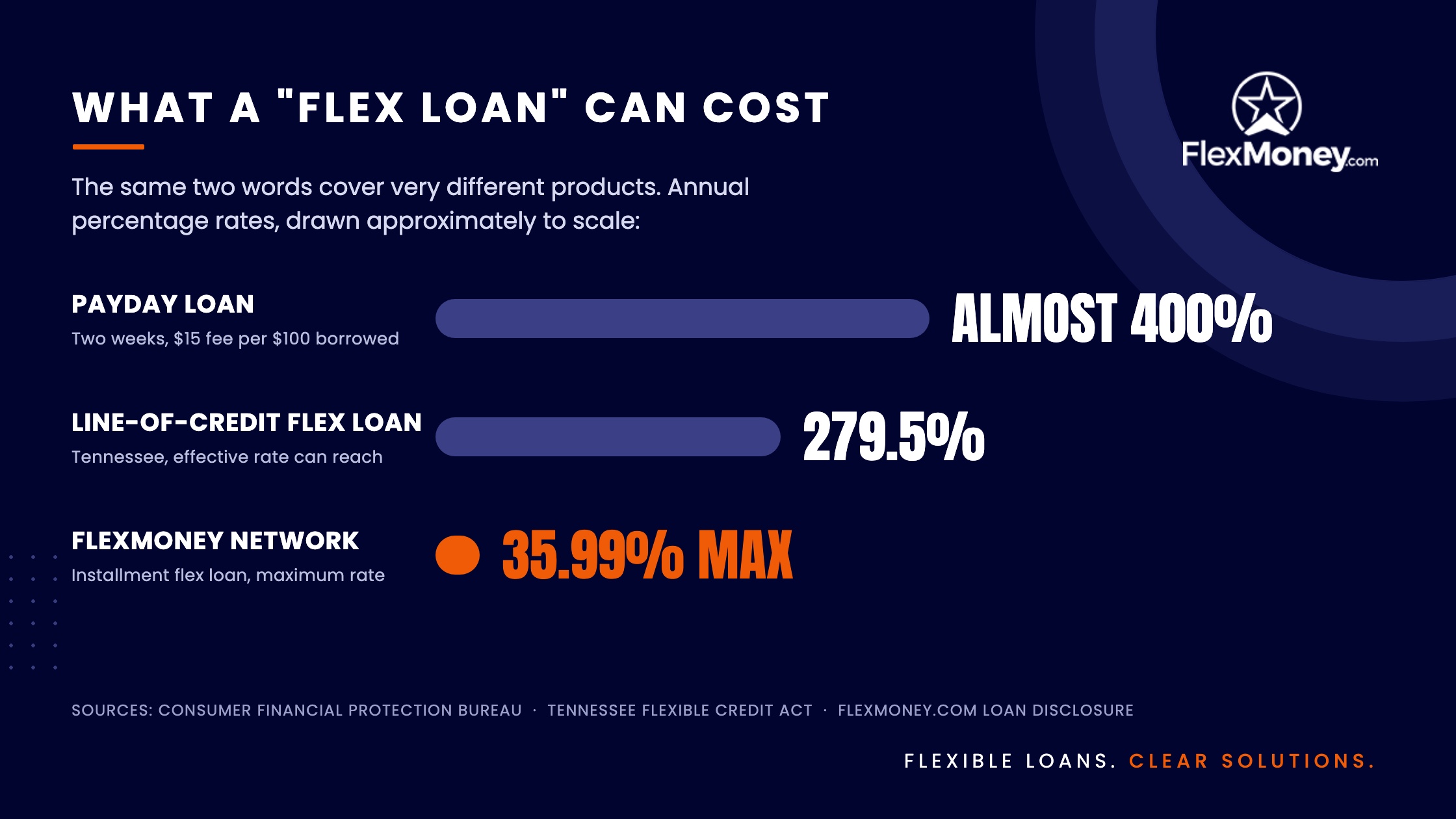
- The two versions carry wildly different annual percentage rates, because Tennessee’s line-of-credit flex loans can reach an effective rate of 279.5%, while every lender in the FlexMoney network caps its annual percentage rate at 35.99%.
- Flex loans through FlexMoney run from $200 up to $35,000, though not every lender offers the top amount, with repayment plans of 12 to 30 months, and lenders can fund as soon as the next business day.
- Lenders in the network consider applicants with a range of credit backgrounds, but they may run a credit check, and nobody can promise approval.
- A flex loan makes sense for a one-time expense you can repay on a schedule. It’s a poor fit for ongoing shortfalls, where a revolving balance keeps running up charges.
A flex loan is a short-term loan built for flexibility, and the phrase means two different products depending on who’s offering it. Storefront and some online lenders use “flex loan” for an open line of credit you can draw from repeatedly up to a limit, while online lending platforms like FlexMoney USA use it for installment loans with a fixed payment schedule, funding as soon as the next business day, and the freedom to pay the balance off early without a penalty.
That difference is the whole reason to read this guide. Search for “flex loans online,” and you’ll find both products described with the same two words, and one of them can carry an annual percentage rate about eight times higher than the other. Knowing which kind you’re looking at is the difference between a manageable monthly payment and a balance that never seems to shrink.
Understanding Flex Loans Online: Are They the Right Financial Tool for You?
Before you map out a plan for an unexpected expense, you can look as an option at a flex loan online to see how customized terms align with your immediate budget needs. A flex loan functions dynamically depending on its construction: storefront models typically mirror an unsecured open line of credit, whereas online platforms like FlexMoney USA facilitate fixed-rate installment paths featuring predictable, fixed monthly allocations and no structural penalties for early settlement.
FlexMoney is a loan-matching platform that sends one request to a network of lenders, who then make their own credit decisions. When FlexMoney talks about flex loans, it means the installment loans those lenders offer, which is the version this guide focuses on. Where the two products differ in a way that matters to your wallet, we’ll say so.
How Does a Flex Loan Work?
Both versions start the same way, with an online request, and what happens after approval is where they split. When analyzing how an option fits your situation, consider the internal logistics of the matching process. FlexMoney’s matching form takes about five minutes to complete, and to build a reliable draft of your options, prepare your checking account routing details, verifiable recurring income totals, which can include alternative streams like disability or pension benefits, and basic residency timelines before you submit your match request.
Lines of Credit
With an open-end flex loan, the lender approves a credit limit rather than a loan amount. You draw what you need, and interest plus any daily or monthly fees accrue only on the balance you’ve drawn. The minimum payment each month is often small, which feels affordable until you notice how little of it reaches the principal.
Tennessee’s Flexible Credit Act is a clear example. It lets these lenders combine 24% annual interest with a daily charge of up to 0.7% of the balance, which can add up to an effective annual percentage rate of 279.5%. Because borrowers can re-borrow whatever principal they’ve paid down, the balance can stay open for as long as the borrower keeps drawing on it.
Installment Loans
With an installment flex loan, the lender deposits a lump sum and gives you a repayment schedule up front. Each payment covers interest and a slice of principal, so the balance falls every month and the loan has a real end date. There’s no balance to re-draw, which is exactly why this version is easier to budget for.
Through the FlexMoney network, that looks like this: loan amounts from $200 up to $35,000, repayment plans of 12 to 30 months, and a maximum annual percentage rate of 35.99%, including interest, fees, and other costs. The site’s own disclosed example is a $4,300 loan at 35.99% over 30 monthly payments of $219.36, for a total of $6,581.78 repaid. That example uses the network’s maximum rate, and the rate, amount, and term on any real offer depend on the lender and on your application.
Flex Loans Compared With Installment and Payday Loans
The clearest way to understand a flex loan is to put it next to the two products it gets confused with.
| Feature | Line-of-credit flex loan | Installment flex loan (FlexMoney network) | Payday loan |
| How the money arrives | You draw any amount up to an approved limit, as often as you like. | The lender deposits one lump sum into your bank account. | The lender deposits one lump sum, usually $500 or less. |
| How you repay | You make a monthly minimum payment while the balance stays open with no fixed end date. | You make equal monthly payments over a fixed term of 12 to 30 months. | You repay the full amount plus the fee in a single payment on your next payday. |
| What it costs | State laws often allow triple-digit annual percentage rates, and daily fees are common. | The annual percentage rate is capped at 35.99% for every lender in the network. | A $15 fee per $100 on a two-week loan equals an annual percentage rate of almost 400%. |
| Best use | Small, irregular draws you can clear the same month. | A one-time expense you want to spread over a predictable schedule. | A small gap you can cover in full on your next paycheck. |
The payday figures come from the Consumer Financial Protection Bureau, which notes that a typical two-week payday loan with a $15-per-$100 fee works out to an annual percentage rate of almost 400 percent. If you’re weighing those two options specifically, our guide to payday loans versus installment loans walks through the math in more detail.
What a Flex Loan Costs
Cost is where the “flex loan” label does the most damage, because it hides a range of annual percentage rates that runs from under 12% to nearly 300%.
The Federal Reserve’s consumer credit release for the second quarter of 2026 puts the average rate on a 24-month personal loan at a commercial bank at 11.86%, and the average rate on credit card accounts assessed interest at 22.15%. These are benchmark rates reported by banks, not a rate any one borrower should expect.
For everyone else, the number to anchor on is 36%. Consumer advocates treat a 36% annual percentage rate as the ceiling for affordable small-dollar credit, and the National Conference of State Legislatures lists Colorado, Montana, Nebraska, and New Hampshire among the states that cap short-term loan rates at 36%. Every lender in the FlexMoney network sits just under that line at 35.99% or lower, in every state the platform serves.
Two rules follow from this, and the first is to find the annual percentage rate on any flex loan offer before you accept it, not the “daily fee” or “monthly charge,” because the annual figure is the only one that lets you compare products. The second is that a lender who won’t state the annual percentage rate plainly has already told you what you need to know about the lender.
Annual percentage rate isn’t the whole story, though. A 30-month installment loan can cost more total dollars than a two-week loan repaid on time, even at a far lower rate, because interest runs for longer. Compare the total amount repayable on each offer as well as the rate, and choose the shortest term whose payment you can manage.
Who Flex Loans Suit, and Who Should Skip Them
A flex loan through an online lender network suits a specific kind of borrower, and it’s worth being honest about who that is.
- You have a one-time expense with a known price. A transmission repair, a dental bill, a security deposit, or a move all have a number attached, and an installment loan matches that number to a fixed schedule.
- Your credit is fair or poor but your income is steady. Lenders in the FlexMoney network consider applicants with a range of credit backgrounds, so a low score doesn’t rule you out automatically, though it can affect the rate and amount you’re offered.
- You want the loan to have a real end date. A fixed term means you can see the payoff date on day one and pay it off earlier without a penalty if a tax refund or a bonus lands.
Skip a flex loan, in either form, if you’re borrowing to cover a recurring gap between income and bills. A loan can’t fix a monthly shortfall, and a revolving flex line makes it worse, because the minimum payment keeps the balance alive while fees keep accruing. Our guide to emergency expenses and when a loan makes sense covers the alternatives worth trying first.
How the FlexMoney Matching Process Works
The process is designed to take minutes, and knowing what happens at each step removes most of the anxiety.
- Form Profile: A user inputs fundamental financial details via the centralized FlexMoney online loans hub, profiling their current income cadence and banking structure.
- Network Routing: The automated framework distributes the criteria across the FlexMoney lender network. Lenders may run a credit check through Experian, Equifax, or TransUnion, or an alternative credit check, to measure debt-to-income viability.
- Offer Evaluation: If a lender match occurs, a clear offer arrives detailing the annual percentage rate, total cost, and term length. You can look as an option at these disclosures carefully, knowing there is zero obligation to move forward.
- Funding Distribution: Upon digital verification of an offer, network lenders typically coordinate automated clearinghouse deposits that can land as soon as the next business day, depending on how your specific bank schedules inbound transactions.
FlexMoney’s network serves 22 states, including Ohio, Texas, Georgia, and Utah. If you need money faster than a scheduled loan allows, the get money now online page explains which options in the network fund fastest, and if approval speed is your main concern, the online installment loans with instant approval page explains what “instant” really means.
Are Flex Loans a Good Idea for an Emergency Expense?
Yes, when the emergency has a fixed price, and you’d otherwise reach for a payday loan or a high-rate line of credit. An installment flex loan at 35.99% or lower carries a fraction of the annual percentage rate of a 279.5% flex line or a 400% payday loan, and it comes with a payoff date instead of an open tab.
No, when the “emergency” is really the same shortfall arriving every month. In that case, a loan buys one month and adds a payment to the next, and the better move is to attack the shortfall itself: negotiating a payment plan with the biller, checking for hardship programs, or picking up extra income for a few weeks.
Matching a Flex Loan to a Real Expense
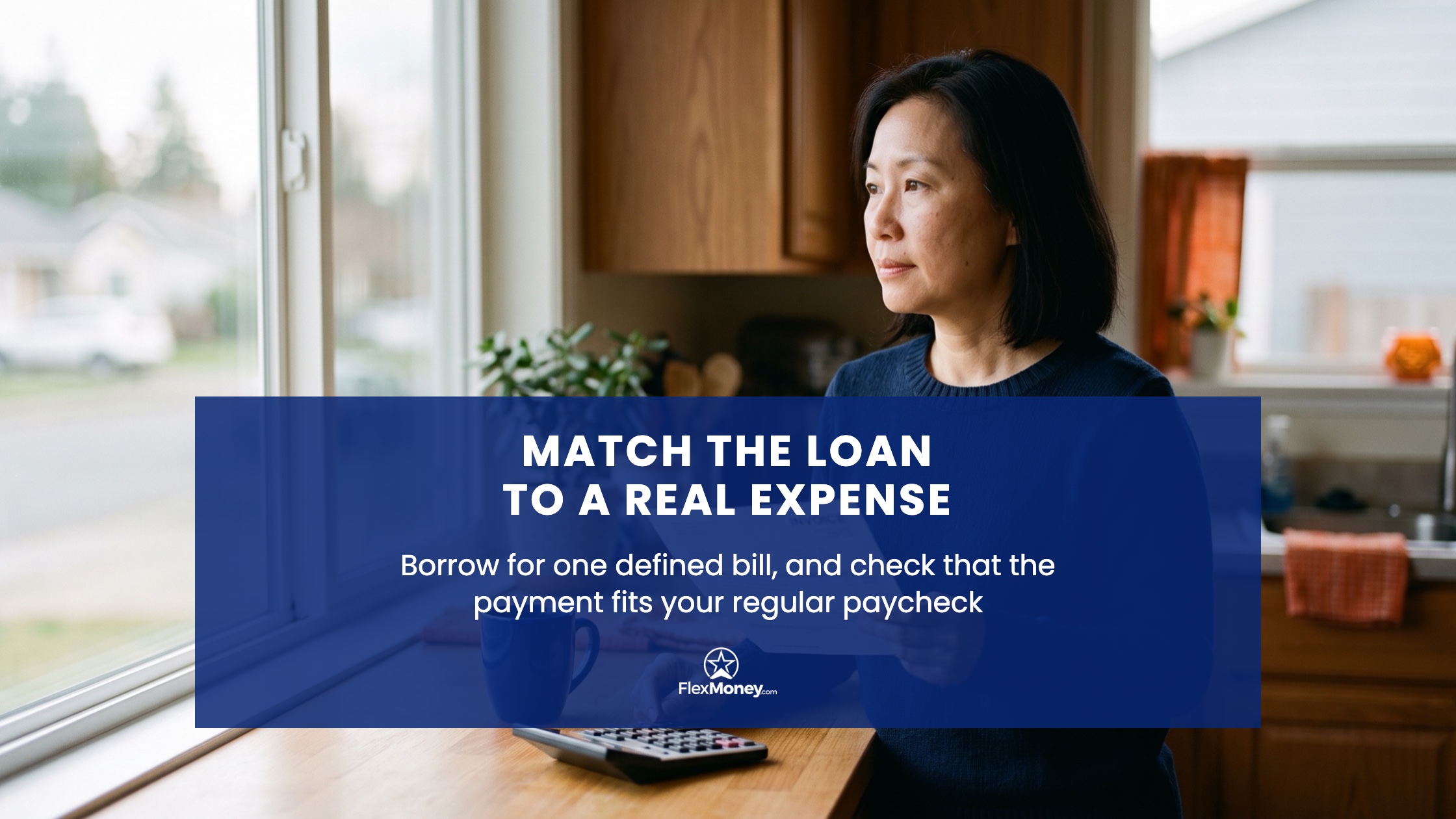
The most sustainable way to use small-dollar funding is to match the loan amount strictly to a defined, one-time invoice, such as a specific mechanical estimate or an unexpected medical deductible. If you are navigating a temporary budget gap, you can look as an option at the FlexMoney connection network to evaluate how lenders in the network structure bad-credit installment solutions. Always verify that your monthly payment fits securely within your regular paycheck cycles before finalizing a digital loan agreement.
FlexMoney.com is not a lender and does not make credit decisions; providing your information does not guarantee approval; lenders may perform credit checks, and the service and its lenders are not available in all states.
Frequently Asked Questions
What is a flex loan and how does it work?
A flex loan is a short-term loan built around flexibility, and the term covers two products. With many storefront lenders, it’s an open line of credit you draw from up to a limit and repay with monthly minimums, often at triple-digit annual percentage rates. Through online platforms like FlexMoney, a flex loan is an installment loan: a lender deposits a lump sum, you repay it in fixed monthly payments over 12 to 30 months, and you can pay it off early without a penalty.
Flex loan vs installment loan: which is better for me?
Through the FlexMoney network they’re the same product, so the real comparison is a fixed-term installment loan against a revolving flex line of credit. Choose the installment loan when you have a one-time expense and want a set payoff date, because every payment reduces the balance and the annual percentage rate is capped at 35.99%. A revolving line only wins for small, irregular draws you can clear within the month, and it becomes expensive fast if you carry a balance.
Can I get a flex loan online with no credit check?
Lenders in the FlexMoney network may run a credit check, either through the three major bureaus or through an alternative provider, so “no credit check” isn’t something FlexMoney promises. Lenders in the network consider applicants with a range of credit backgrounds, which is why a low score doesn’t rule you out automatically. Be cautious with any lender advertising loans with no credit check at all, since that claim usually comes attached to the highest rates in the market.
Where can I get a flex loan online today with same-day funding?
FlexMoney’s one-form request reaches multiple lenders in 22 states, and lenders in the network can fund approved loans as soon as the next business day. Same-day funding isn’t something FlexMoney promises, because the timing depends on the lender, the time you sign, and how quickly your own bank posts deposits. Submitting early on a business day, with accurate bank details and income information, can help avoid delays.
Are flex loans available for bad credit?
Yes, lenders in the FlexMoney network consider applicants with a range of credit backgrounds, including bad credit. A lower score may mean a higher annual percentage rate within the network’s 35.99% cap and a smaller approved amount, so requesting only what you need keeps the payment smaller at the same rate and term. Nothing guarantees approval, and each lender makes its own decision.