

Key Takeaways
- DTI compares monthly debt payments to gross income.
- A lower DTI can leave more room for new payments.
- Front-end and back-end DTI measure different obligations.
- Paying down debt can help lower your DTI.
- Consider your full budget before taking on another loan.
Your credit score may get most of the attention when you’re thinking about a loan, but it’s not the only number lenders may consider. Your debt-to-income ratio (DTI) can also help show how much of your monthly income is already committed to debt payments.
That matters because taking on a loan means adding another payment to your budget. Understanding your DTI can help you see where you stand before borrowing, what lenders may consider when reviewing an application, and whether another monthly payment realistically fits your finances.
Here’s how to calculate your DTI, what goes into the number, and what you can do if yours is higher than you’d like.
Your DTI Answers One Important Question: How Much Is Already Owed Each Month?
Your debt-to-income ratio compares your recurring monthly debt payments with your gross monthly income. The result is expressed as a percentage.
For example, if a significant portion of your income already goes toward your mortgage or rent, car loan, student loans, and credit card minimums, there may be less room in your budget for another payment.
Lenders can use DTI as one part of evaluating that picture. Your credit history can provide information about how you’ve managed credit in the past, while DTI provides another perspective: how much of your income is already committed right now?
A lower DTI generally means a smaller portion of your income is tied to existing debt. A higher DTI means more of your income is already spoken for.
Does a 43% DTI Automatically Mean No? Not Necessarily.
You may have seen 43% described as an important DTI cutoff, particularly when researching mortgages. The reality is more complicated.
The Consumer Financial Protection Bureau’s Qualified Mortgage rules have historically made DTI an important consideration in mortgage lending, but there isn’t one universal DTI limit that determines approval for every borrower or every type of loan.
Mortgage requirements can also differ from the criteria used for personal loans. Lenders may consider your DTI alongside your credit history, income, requested loan amount, existing obligations, and their own eligibility requirements.
The takeaway is simple: DTI matters, but one percentage doesn’t tell the entire story.
Grab a Calculator: Finding Your DTI Is Pretty Simple
You don’t need a complicated financial model to calculate your debt-to-income ratio.
Start with:
DTI Ratio = Total Monthly Debt Payments ÷ Gross Monthly Income × 100
Step 1: Find Your Gross Monthly Income
Your gross monthly income is what you earn before taxes, health insurance premiums, retirement contributions, and other deductions.
If you’re salaried, you can usually find this amount on your pay stub. If your income varies because you’re self-employed, freelance, or earn money from multiple sources, determining qualifying income may require additional documentation.
Individual lenders can have different requirements for what income they’ll consider and how they verify it.
Step 2: Add the Monthly Debt Payments That Count
Next, add the recurring debt payments that may be included in your DTI.
Depending on your circumstances and the type of loan, these can include:
- Rent or mortgage payments
- Auto loan payments
- Student loan payments
- Personal loan payments
- Minimum credit card payments
- Certain court-ordered obligations, such as alimony or child support
Everyday expenses such as groceries, utilities, gas, and streaming subscriptions generally aren’t included in the standard DTI calculation.
That doesn’t mean you should ignore them when deciding whether you can afford another loan. Your lender’s calculation and your actual household budget aren’t necessarily the same thing.
Step 3: Put the Numbers Together
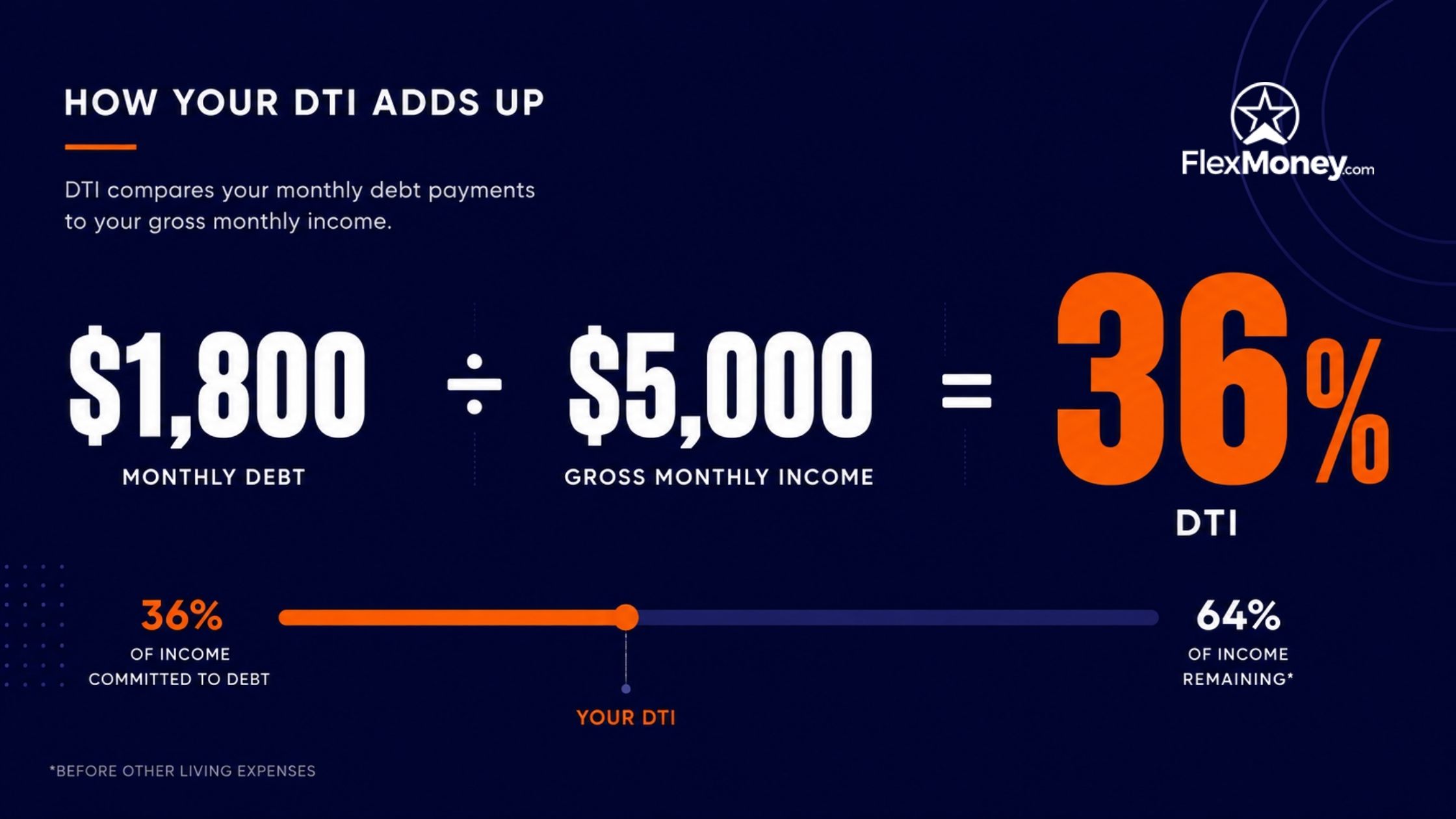
Suppose your qualifying monthly debt payments total $1,800 and your gross monthly income is $5,000.
Your calculation would be:
$1,800 ÷ $5,000 × 100 = 36%
Your DTI is 36%.
That means 36% of your gross monthly income is currently going toward the debt payments included in the calculation.
Front-End vs. Back-End DTI: Why You May See Two Different Numbers
If you’ve started researching DTI, you may have encountered two different versions: front-end DTI and back-end DTI.
Front-End DTI Looks at Housing
Front-end DTI, sometimes called the housing ratio, compares qualifying housing expenses with your gross monthly income.
For homeowners, that can include expenses such as the mortgage payment, property taxes, homeowners insurance, and homeowners association fees.
Back-End DTI Looks at the Bigger Picture
Back-end DTI adds other recurring debt obligations to the calculation.
That can include housing costs plus:
- Auto loans
- Student loans
- Personal loans
- Minimum credit card payments
- Other qualifying recurring debts
Which ratio matters most depends on the lender and the type of credit you’re considering.
Practical Ways to Optimize Your Ratio Before Applying
- The Rebalancing Strategy: If your current calculation is higher than you would like, you can take practical steps to rebalance your finances before submitting a loan application.
- Accelerate balance paydowns: Focus extra cash allocation directly toward lower-balance credit lines. Reducing a card balance to zero eliminates its minimum required monthly payment from your calculation, immediately dropping your total debt overhead.
- Avoid new credit draws: Do not open new credit lines, finance vehicles, or make major deferred-interest purchases right before applying for personal funding.
- Document alternative revenue: Ensure your reported income includes verifiable secondary revenue sources, such as freelance contract work, regular rental income, or consistent investment dividends.
If your financial history shows responsible credit management but your current debt-to-income ratio is temporarily uneven due to seasonal cash flows or a sudden emergency expense, exploring alternative funding platforms can be a helpful step. For those seeking accessible personal funding structures that look beyond rigid legacy bank requirements, considering flexible online lending solutions can provide a practical path forward.
Reviewing technology-driven, web-based online loans allows you to compare alternative approval criteria tailored to your current situation. Utilizing digital financial networks that focus on clear terms and streamlined verification parameters helps you securely explore customized installment loans online without navigating the extensive in-person delays common at brick-and-mortar institutions.
So, What Is a “Good” Debt-to-Income Ratio?
It’s tempting to look for one percentage that tells you whether your DTI is good or bad. In practice, it’s better to treat DTI ranges as reference points rather than guaranteed approval thresholds.
35% or Lower: More Room in the Budget
A smaller share of your gross income is committed to recurring debt payments. That can leave greater flexibility for everyday expenses, savings, emergencies, and potentially another payment.
36% to 43%: Take a Closer Look
Your existing debt is taking up a larger share of your income. Before borrowing more, look closely at how the proposed payment would fit alongside your regular expenses.
44% to 49%: Your Budget May Be Getting Tight
At this point, a significant portion of your income is already committed to debt. Depending on the lender and loan product, a higher DTI could affect eligibility or the terms available to you.
50% or Higher: Another Payment Deserves Careful Consideration
If half or more of your gross income is already committed to debt payments, there may be considerably less flexibility for unexpected expenses or another financial obligation.
Remember that lenders can use different eligibility requirements. A DTI percentage by itself doesn’t guarantee loan approval, rejection, a particular interest rate, or specific loan terms.
DTI and Credit Utilization Sound Similar. They Aren’t.
These two financial ratios are easy to confuse because both involve debt, but they measure very different things.
Credit utilization compares your revolving credit balances with your available revolving credit limits.
If you have a credit card with a $10,000 limit and a $3,000 balance, for example, that card has a 30% utilization rate.
DTI, on the other hand, compares qualifying monthly debt payments with your gross monthly income.
That’s an important distinction.
Paying down a credit card can lower your credit utilization. But simply reducing the balance doesn’t necessarily remove its monthly payment from your DTI calculation. Paying the account off may eliminate that required payment, depending on how the lender calculates your obligations.
What Counts Toward DTI and What Doesn’t?
Here’s where DTI can become confusing.
Usually Included
Depending on the lender and type of application, DTI may include:
- Mortgage or qualifying housing payments
- Auto loans
- Student loans
- Personal loans
- Minimum credit card payments
- Certain court-ordered debt obligations
Usually Not Included
Everyday expenses generally aren’t part of the standard calculation, including:
- Groceries
- Utilities
- Gas
- Streaming subscriptions
- Many insurance expenses
- Other routine household spending
There’s an important catch: an expense not appearing in your DTI doesn’t mean it disappears from your budget.
A loan payment that technically fits a lender’s DTI requirements could still put pressure on your finances once groceries, utilities, transportation, insurance, childcare, and other expenses are taken into account.
Use DTI as one tool, not as the sole measure of what you can afford.
Two Accounts That Can Make DTI More Complicated
Not every debt situation fits neatly into a calculator. Authorized-user accounts and co-signed loans are two good examples.
You’re an Authorized User on Someone Else’s Card
An authorized-user account may appear on your credit report even though you’re not the primary account holder.
How a lender treats that account when calculating DTI can depend on the lender, loan type, and whether you’re actually responsible for making the payments.
If an authorized-user account appears on your credit report, don’t automatically assume it will or won’t count. Ask the prospective lender how it handles these accounts.
You Co-Signed Someone Else’s Loan
Co-signing carries considerably more responsibility.
When you co-sign a loan, you’re agreeing to be responsible for the debt if the primary borrower doesn’t pay. That obligation may therefore be considered when a lender evaluates your existing debts.
Some lenders or loan programs may treat a co-signed debt differently when specific requirements are met, so check the applicable criteria rather than assuming the payment will automatically be excluded.
Want to Lower Your DTI? Focus on These Two Numbers
Your DTI formula has two sides: monthly debt payments and gross monthly income. If you want to improve your ratio, those are the places to start.
Pay Off Debt Where It Makes Sense
Paying off an individual debt may remove its monthly payment from your DTI calculation.
The debt snowball method focuses on smaller balances first, while the debt avalanche method prioritizes higher-interest debt. Each approach has different advantages, so the right choice depends on your finances and goals.
Avoid draining your emergency savings simply to reach a particular DTI percentage. Your broader financial stability matters too.
Be Careful About Adding New Debt
A new auto loan, financed purchase, personal loan, or other credit obligation could add another monthly payment to your DTI.
If you’re considering a significant loan in the near future, look at how any new borrowing beforehand could affect both your DTI and your actual monthly budget.
Make Sure Your Qualifying Income Is Accounted For
Depending on a lender’s requirements, qualifying income may extend beyond your primary paycheck.
Regular and verifiable income from freelance work, retirement benefits, rental properties, or other sources may sometimes be considered.
Don’t assume every deposit into your account qualifies as income for lending purposes. Requirements can vary, particularly for self-employed borrowers and people with irregular income.
Before Another Loan, Look at the Payment — Not Just the Approval
A DTI calculation can help you understand whether your existing debt leaves room for another payment. But qualifying for credit and comfortably repaying it are two different questions.
Before borrowing, consider:
- Why do you need the money?
- Can the expense be reduced or delayed?
- Do you have savings available?
- What would another payment do to your monthly budget?
- How much will borrowing cost in total?
- Could you still manage the payment if another unexpected expense came up?
If you’ve reviewed your budget and alternatives and a temporary financial gap remains, you can look at FlexMoney as one option for exploring available borrowing solutions.
Know Your Number Before You Add Another Payment
Your DTI isn’t a grade on your financial health. It’s a snapshot of how much of your gross monthly income is already committed to debt.
That makes it useful well before you fill out a loan application.
Calculate it when your income changes, when you pay off a debt, or before considering another significant financial obligation. Then look beyond the percentage at your actual monthly budget.
The goal isn’t simply to reach the “right” DTI. It’s to understand what you already owe, what you can realistically manage, and whether taking on another payment makes sense for your financial situation.
Considering Borrowing? Understand Your Options First
Your DTI can help you see how another monthly payment could affect your finances before you make a decision. If you have a temporary financial need and are considering borrowing, you can look at FlexMoney as one option to learn more about online loans and installment loan options. Always review the costs and repayment terms before deciding whether a loan is appropriate for your situation.
FAQs
What is a debt-to-income ratio?
A debt-to-income ratio compares your recurring monthly debt payments with gross monthly income before taxes. Use the debt-to-income ratio formula: total monthly debt payments divided by gross monthly income, multiplied by one hundred. The result shows how much income is already committed to debt, not what you spend on groceries or utilities. A debt-to-income calculator or budget calculator can make the math easier. It is a useful affordability check before you apply, especially when you are considering a new mortgage payment or other borrowing.
What payments count toward DTI?
Lenders may count recurring debt such as mortgage or rent payments, monthly mortgage payments, car loans, auto loans, student loan payments, personal loans, credit card minimums, credit card monthly payments, and other monthly loan payments. Child support, monthly alimony, child support or alimony obligations, and alimony or child support payments may also count. Everyday costs, such as food, utilities, and subscriptions, usually are not part of standard DTI. Still, include them in your personal budget: a payment can fit a lender’s calculation while remaining uncomfortable in real life.
What is the difference between front-end and back-end DTI?
Front-end DTI, often called a housing ratio, compares monthly housing costs with gross monthly income. Housing costs can include a mortgage payment, property taxes, homeowners insurance, and applicable association fees. Back-end DTI includes those housing costs plus recurring monthly debts, such as credit card debt, student loans, personal loans, and a minimum payment on each account. A monthly rent or house payment may be treated differently depending on the loan type. Ask the lender which ratio its financing guidelines use.
What is a good debt-to-income ratio?
A lower DTI can leave more room for savings and unexpected costs, but there is no universal maximum DTI that guarantees loan approval or rejection. Qualified mortgages, personal loans, and other borrowing options can use different qualification requirements. A lender may review front-end DTI, back-end DTI, gross monthly income, housing costs, auto loan payments, student loan payments, personal loan payments, and minimum credit card payments together. Treat ranges as a budgeting signal, not a grade on your financial health.
Why does DTI matter when applying for a loan?
DTI matters because it helps lenders assess whether another monthly debt payment may fit alongside your current obligations. During underwriting, a lender can combine income verification, credit history, credit score, and DTI as part of its risk assessment and lending decisions. It is only one piece of the picture; loan approval, loan terms, interest rate, and available borrowing options also depend on a lender’s qualification requirements and financing guidelines. Reviewing your own financial health first helps you borrow more confidently.
How can I improve my debt-to-income ratio before applying?
To improve DTI, focus on either lowering monthly debt payments or increasing stable, verifiable gross monthly income. Start with a budget that identifies nonessential expenses and directs extra cash to high-interest balances. The debt avalanche targets the highest interest rates first, while the debt snowball method pays smaller balances first for momentum. A balance transfer, refinancing, or debt consolidation loan may reduce a payment, but compare fees, repayment term, and total cost carefully. Avoid adding new credit before an application.
Should I use a balance transfer or debt consolidation loan to lower DTI?
A balance transfer or debt consolidation loan can help when it reduces interest costs, simplifies repayment, or lowers required monthly debt payments. Compare interest rates, transfer fees, the repayment term, and the total cost—not just an introductory offer. Refinancing can extend a term and reduce the payment while increasing overall interest. A student loan payment estimator can help you understand education-debt payments before applying. Keep making payments on time, and do not use newly available credit to add balances back after consolidating.
Does paying off a credit card improve my DTI?
Paying off credit card debt can improve DTI when it eliminates a required credit card minimum or credit card monthly payment. It can also lower your credit utilization, which is separate from DTI but may influence your credit score. Review monthly statements to identify the balance, APR, and minimum payment on each account. Directing extra cash to the most expensive debts through the avalanche method can reduce interest costs. Keep an emergency buffer so a surprise expense does not send you back to revolving balances.
Do co-signed loans or authorized-user accounts affect DTI?
A co-signed loan can affect DTI because you are legally responsible if the primary borrower does not pay. An authorized-user credit card may appear on credit reports, but whether its payment is included can vary by lender, loan program, and documentation. Do not assume either recurring debt will be ignored. Before applying, ask how the lender handles other debts, recurring debt, and shared obligations. Keeping records of who makes payments may help explain your situation, but the lender’s underwriting policies control the final decision.
Can a higher DTI still qualify for a loan?
A higher DTI does not automatically rule out loan approval. Lenders may consider compensating factors, including strong credit history, a higher credit score, reliable income verification, savings, or a larger down payment where relevant. The weight of these factors varies by product, lender, and its risk assessment process. Do not rely on a single cutoff or assume that one lender’s decision applies everywhere. Instead, compare loan terms, confirm the new monthly debt payment fits your budget, and borrow only what you can repay.
How should I budget for a new loan payment?
Before accepting a loan, add the proposed monthly debt payment to a full household budget, not only to your DTI. Include rent or mortgage, living costs, insurance, transportation, savings, and room for an emergency. Confirm how the payment changes your cash flow after all recurring debt and minimum credit card payments. FlexMoney connects consumers with lenders offering options such as personal loans and installment loans; lender-specific rates, terms, eligibility, and funding timing can vary. Review every offer carefully before you commit.
What should I know before using FlexMoney to explore loan options?
FlexMoney is a nationwide U.S. online platform that connects borrowers with lenders offering flex loans, small cash loans, personal loans, and installment loans. The platform advertises a fully online process, predictable payments with a fixed interest rate, fast funding that may be available as soon as the next business day, and no prepayment penalty. Actual loan approval, rates, funding timing, and repayment terms depend on the lender and your application. Calculate DTI, compare total borrowing costs, and review every disclosure before accepting an offer.