
Key Takeaways
- Lenders can consider borrowers with bad credit, but each lender sets its own eligibility rules, and a lower score can affect the amount, rate and term you’re offered.
- Under Ohio’s short-term loan law, a short-term loan can’t exceed $1,000 and generally runs for at least 91 days and no more than one year, with interest capped at 28% a year plus limited fees.
- FlexMoney is a loan marketplace, not a direct lender. It connects your request with participating lenders, and loans through its network range from $200 to $35,000 over 12 to 30 months at an annual percentage rate (APR) of 35.99% or lower.
- Any lender making loans in the state should hold the right license, which you can check with the state’s Division of Financial Institutions before you sign.
- Your credit reports are free to check every week, and reviewing them before you request a loan can help you spot errors that affect what lenders see.
A lower credit score can make borrowing in Ohio feel uncertain, but lenders can still consider your request. State law caps short-term loans at $1,000 and generally requires them to run at least 91 days, and many lenders weigh your income alongside your credit history. If you’re comparing online loans in Ohio, start with three questions: what state law allows, what lenders look at, and who makes the final decision on your request.
FlexMoney’s lender network is one way to explore your options. One online request can reach participating lenders that serve your state, and if a lender makes an offer, you can review the APR, the payment, and the total cost before you decide.
What Does “Bad Credit” Mean to a Lender?
Bad credit usually means a credit history with late payments, accounts in collections, high balances compared with your limits, or a short track record. There’s no single cutoff score that every lender uses.
State law doesn’t set a minimum credit score for borrowing. Each lender decides how much weight to give your credit history alongside your income, your existing payments, and the loan amount you request.
Many lenders look at your debt-to-income ratio, which compares your monthly debt payments with your income. A steady income and a manageable ratio can help when your score is lower.
Checking your credit reports first shows you what lenders will see. The Federal Trade Commission explains how to get free credit reports every week from Equifax, Experian and TransUnion through AnnualCreditReport.com. If you find an account that isn’t yours or a payment marked late in error, you can dispute it with the credit bureau.
What Are Ohio’s Rules for Short-Term Loans?
Rules checked in October 2026.
Ohio’s short-term loan law sets clear limits on loans of $1,000 or less. Those limits cover both how long the loan runs and what it can cost.
Under Ohio’s rules, a short-term loan:
- Can’t exceed $1,000.
- Must run at least 91 days and no more than one year.
- Can run shorter than 91 days only if each monthly payment stays within 6% of your gross monthly income or 7% of your net monthly income, whichever is greater.
Costs are limited too. State law caps interest at 28% a year and allows a monthly maintenance fee of no more than 10% of the original loan amount or $30, whichever is less. Those fees must be included in the APR, so the APR on a short-term loan will be higher than the 28% interest rate alone.
On a $500 short-term loan, 10% would be $50, so the $30 limit applies. Over a six-month term, maintenance fees alone could reach $180 before any interest.
A quick example shows how the income test works. If your gross monthly income is $3,000, 6% of that is $180. A short-term loan with a term under 91 days would need monthly payments of $180 or less, or the 91-day minimum applies.
If you’re comparing payday loans online in Ohio, these are the rules to know. Because of the 91-day minimum, short-term loans in the state generally run for months rather than two weeks.
What About Loans Over $1,000?
Larger loans and longer terms fall under different state laws, including the Consumer Installment Loan Act, which covers loans with terms of at least six months. Which law applies depends on the loan amount, the term, and the lender’s license.
You don’t need to work that out on your own. A lender’s loan agreement should state the amount, the APR, the payment schedule, and the total cost, and you can look up the lender’s license through the state.
How Do Installment Loans in Ohio Compare With Short-Term Loans?
The two cover different amounts and terms:
| Short-term loan under state law | Loans through the FlexMoney network | |
| Amount | Up to $1,000 | $200 to $35,000 (not every lender offers the top amount) |
| Term | 91 days to one year (shorter only with the income test) | 12 to 30 months |
| Cost limit | 28% yearly interest plus a capped monthly maintenance fee | APR of 35.99% or lower |
| What to check | The lender’s short-term loan license | The lender named on the offer and its license |
How Does the FlexMoney Lender Network Work in Ohio?
FlexMoney doesn’t lend money or make credit decisions. It’s an online lending connection platform: you submit one request, and participating lenders that serve your state review it and decide whether to make an offer.
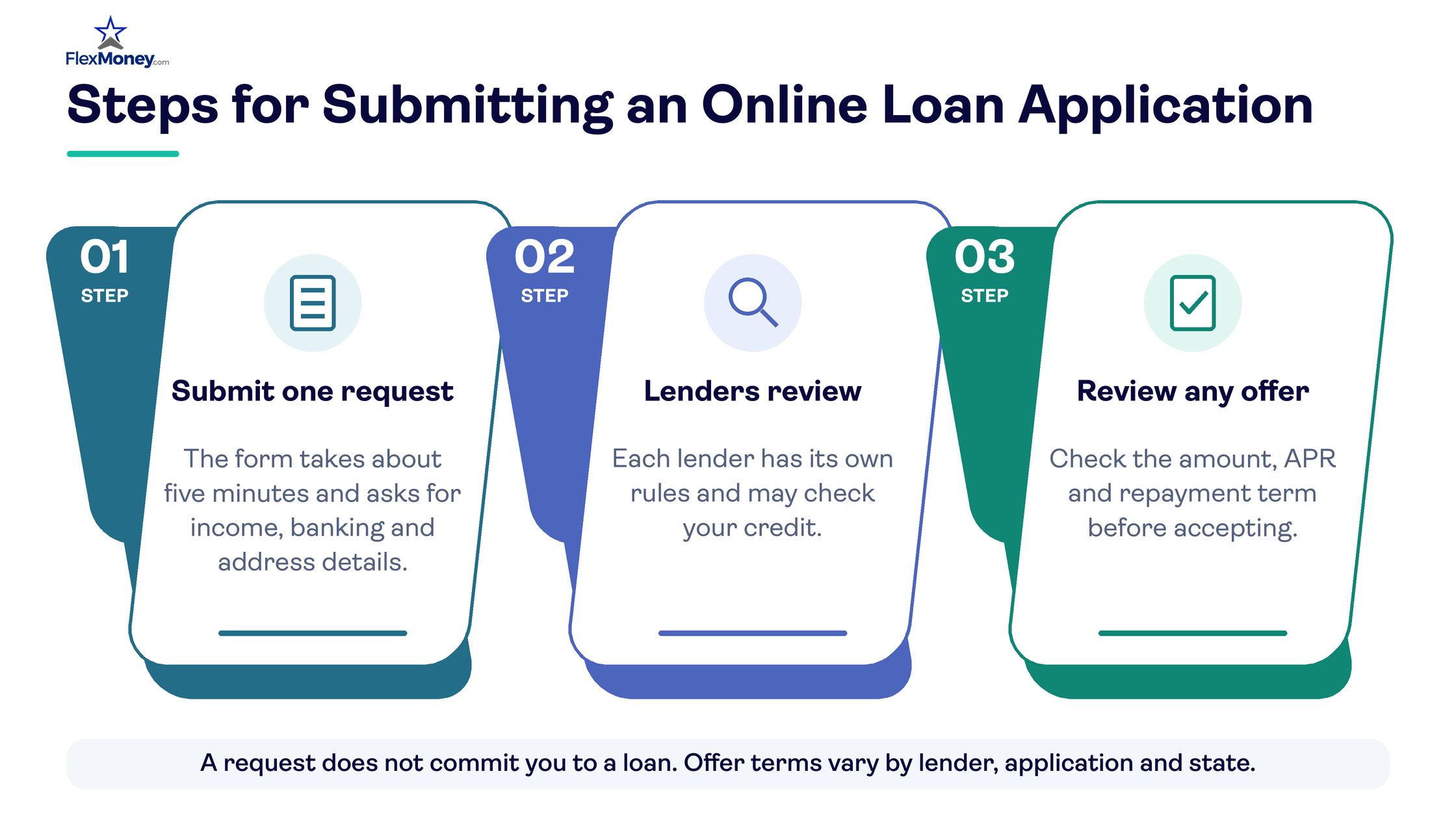
Steps for Submitting an Online Loan Application
Step 1: Submit One Request
FlexMoney’s loan request form takes about five minutes. Submitting a request isn’t the same as accepting a loan. The form asks for details such as your income, your bank account and your address.
Step 2: Lenders Review Your Information
Lenders in the network consider applicants with a range of credit backgrounds. Each lender may run a credit check through Equifax, Experian, or TransUnion, or through a specialty consumer reporting company (a smaller credit bureau listed by the CFPB), and apply its own criteria.
Step 3: Review Any Offer Before You Accept
Loans through the network range from $200 to $35,000, repaid over 12 to 30 months, with an APR of 35.99% or lower. Not every lender offers the top amount, and the amount, rate, and term on any offer depend on the lender, your application, and state rules.
The site’s disclosed example is a $4,300 loan at 35.99% APR, repaid in 30 monthly payments of $219.36, for $6,581.78 in total.
Loans through the network carry a fixed interest rate and no penalty for paying early. If you accept an offer, funds can arrive as soon as the next business day, though transfer times vary between lenders and can depend on your bank. If timing matters most, you can look at fast cash loans online or get money now online as options.
What Can You Realistically Expect With Bad Credit in Ohio?
A lower credit score doesn’t necessarily stop a lender from considering your request for online loans in Ohio. It can change what an offer looks like. With a lower score, you may see a smaller approved amount than you requested, a higher APR within the lender’s range, or a request for more information about your income. Some lenders may not make an offer at all.
A few things can help your request:
- Request only what the expense needs. A smaller amount means a smaller payment at the same rate and term.
- Show steady income. Lenders weigh income alongside credit history, and consistent deposits can help.
- Fix errors first. A corrected credit report can change what a lender sees.
Installment loans spread repayment over months, which can make a payment easier to plan around than a single lump-sum repayment. The page on personal loans in Ohio covers how lenders in the state use that term.
How Do You Check an Ohio Lender Before You Sign?
Whichever online loans in Ohio you compare, the lender named on your offer is the company that funds your loan and collects your payments. That’s the company to check.
The state’s Division of Financial Institutions publishes a Consumer Finance Licensee Lookup that points to the state’s search tools. Search by the lender’s legal business name rather than a website or brand name.
If a problem comes up with a lender, the Division suggests contacting the lender first. If that doesn’t resolve it, you can file a complaint with the Division, which refers complaints about companies it doesn’t regulate to the right agency.
Is a Loan the Right Step for Your Situation?
Before you decide, check the lender named on any offer through the state’s licensee lookup, compare the APR and total cost of borrowing with a payment you can manage, and make sure the first due date falls after your payday. If the numbers work for your budget, you can look at Ohio installment loans online through the FlexMoney lender network as one option. If they don’t, a smaller amount, a different term or another way to cover the expense may be a better fit. Other options to compare include a payment plan with the biller or a payday alternative loan from a federal credit union, which the National Credit Union Administration caps at a 28% APR for loans of up to $2,000.
See What Borrowing Options May Be Available to You
A lower credit score doesn’t automatically rule out every borrowing option. FlexMoney helps you explore potential offers from participating lenders through one online request. Compare any terms you’re offered and decide whether borrowing fits your financial situation.
Frequently Asked Questions
Installment Loans Online in Ohio for Bad Credit
When you request online loans in Ohio through the FlexMoney network, lenders consider applicants with a range of credit backgrounds. Loans through the network are installment loans repaid over 12 to 30 months at an APR of 35.99% or lower. A lower score can affect the amount and rate you’re offered, and each lender makes its own decision.
Online Loans in Ohio From a Direct Lender
A direct lender reviews your application, funds the loan, and collects your payments. FlexMoney isn’t a direct lender. It connects your request with participating lenders, and the lender named on any offer is the direct lender for that loan. You can check that lender’s license through the Division of Financial Institutions before you sign.
What Are Ohio’s Limits on Short-Term Loans?
The state caps short-term loans at $1,000, with a term of at least 91 days and no more than one year, unless the monthly payment stays within 6% of gross or 7% of net monthly income. Interest is capped at 28% a year, plus a monthly maintenance fee of no more than 10% of the loan amount or $30, whichever is less.
Can You Improve Your Chances of a Loan Offer With Bad Credit?
Requesting only what you need, showing steady income, and correcting errors on your credit reports can all help. Each lender still makes its own decision.